


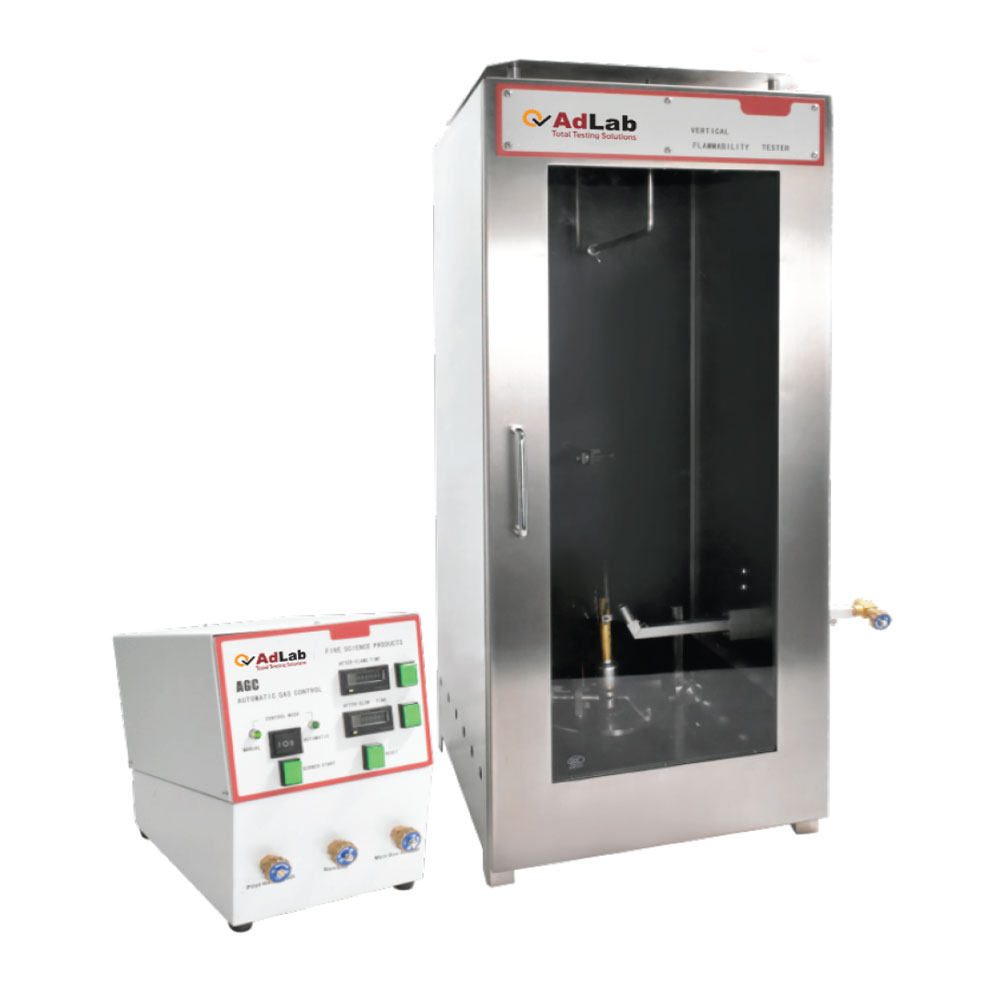
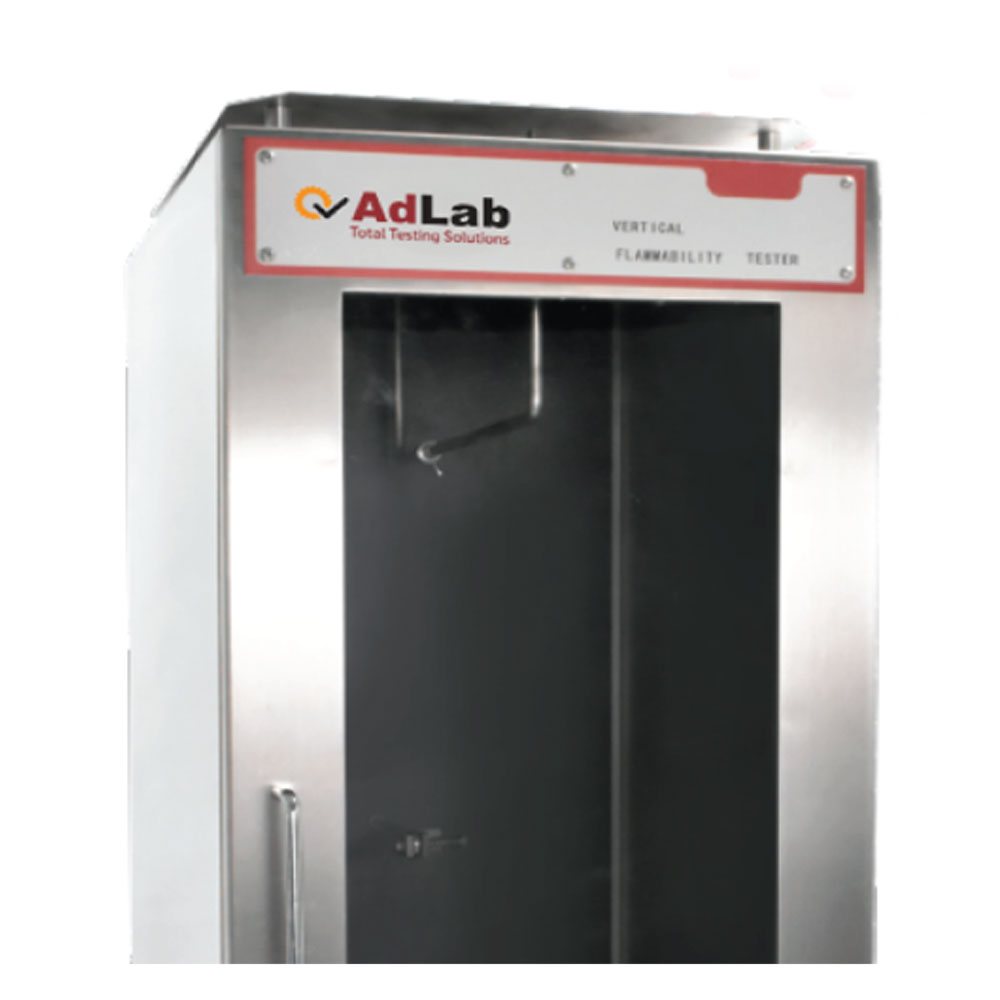
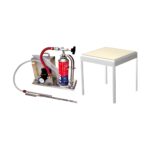
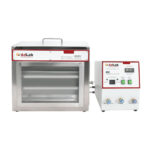
Vertical Flammability Tester
Test vertical flame resistance of textiles and garments. Automatic ignition and precise measurement ensure compliance with federal and international safety standards.
- Automatic ignition with controlled flame height
- Measures flame speed, afterburning, and carbonization length
- Compliant with 16CFR1615, 1616 for children’s wear and safety fabrics
The Vertical Flammability Tester evaluates textile flammability by measuring the flame propagation speed on vertically positioned samples, making it ideal for children’s wear, pajamas, and safety fabrics. It uses a controlled flame ignition system and records afterburning, smoldering times, and flame height. Designed for precision, it follows 16CFR1615, 1616 standards, allowing testing of finished garments, seams, and decorative fabrics. The instrument ensures compliance with federal and international flammability regulations, enabling manufacturers to assess and improve fabric safety effectively.
Experimental Parameters
- Sample size: 80 mm × 300 mm
- Ignition mode: automatic
- Ignition time: 12 seconds
- Ignition device diameter: Φ11 mm
- Afterburning and smoldering time: 0–999.9 seconds
- Flame height: 40 mm
- Gas type: propane, butane, or liquefied petroleum gas
Test principle
This tester ignites the sample at its lowest point and measures flame speed using the vertical method. During testing, the sample stands vertically while a flame with a 38 mm length burns the sample for 3 seconds. Operators determine the flame-burning speed by measuring the distance from the sample’s bottom to the point where the creased sample tears under a specified force.
Sample Preparation and Sampling
- Test sample: Cut cloth pieces measuring 8.9 × 25.4 cm. Include seams or decorations if present, or use finished garments as they are.
- Sampling: Follow 16CFR1615 and 1616. Cut 5 test samples from cloth pieces, seams, decorations, or finished garments.
- Each sample must measure 254 ± 3 mm in length and 89 ± 3 mm in width. Take 2–3 samples along the length and 2–3 along the width to reach 5 total samples per tested material.
- Fabrics for children’s pajamas require testing in their original state and after 50 washes. Non-flame-retardant fabrics without special functions only need testing in their original state. If these fabrics meet federal standards initially, they pass flammability requirements after 50 washes.
Test Procedure
- Turn off the exhaust fan. Open the gas supply and adjust the needle valve so the burner flame measures 38 mm. Close the test chamber door for at least 5 minutes. Dim the room light and adjust the flame to 38 ± 2 mm from the burner’s upper end to the visible flame top.
- Hang the sample on the test chamber rod immediately after removing it from the dryer, within 30 seconds. Position the flame under the sample’s bottom center.
- Ignite the sample for 3.0 ± 0.2 seconds and move the burner away to stop ignition.
- Open the fume hood and exhaust smoke completely. Avoid inhaling fumes and wear proper breathing protection.
- Carefully remove the hot sample clamp and sample. Press a wrinkle along the sample’s length starting from the highest carbonization point.
- Insert a dome hook 6.4 ± 20 mm from the sample’s bottom on the non-carbonized side and hang a heavy hammer on it.
- Lift the other sample end gently until the hammer just leaves the surface. This action tears the burned sample.
- Use a ruler to measure the carbonization length from the torn end to the ignition point and record it.
- Repeat steps 2–8 for all 5 samples.
- Report the average carbonization length of the 5 samples and the maximum carbonization length for each sample.
Why Choose Vertical Flammability Tester?
The Vertical Flammability Tester is essential for textile manufacturers and quality labs aiming to ensure flame safety compliance. It precisely ignites samples at their lowest point and measures flame speed, afterburning, and carbonization length. The instrument accommodates finished garments, seams, and decorative fabrics, allowing testing in real-world conditions, including after multiple washes for children’s sleepwear. It supports propane, butane, or liquefied petroleum gas and features automatic ignition, adjustable flame, and strict sample positioning, ensuring reproducible and reliable results. The tester follows international standards such as 16CFR1615/1616, providing manufacturers with confidence that fabrics meet regulatory requirements while maintaining operational safety and testing efficiency.
Related products


Sweating Guarded Hotplate
Professional Sweating Guarded Hotplate measures thermal and evaporative resistance of textiles, coatings, foams, and multi-layer materials with high precision and reliability.
- Simulates human skin for accurate testing of clothing materials
- Automatic water supply and airflow stabilization for consistent results
- Complies with ISO, ASTM, GB, and JIS standards
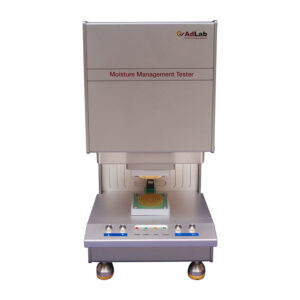
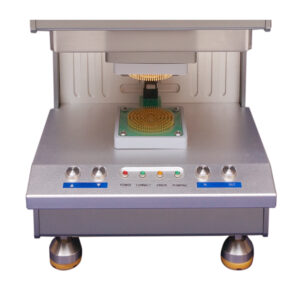
Moisture Management Tester
Professional Moisture Management Tester measures fabric wetting, absorption, and drying behavior with precision, helping manufacturers assess moisture comfort and performance efficiently.
- Measures fabric wetting, spreading, and absorption performance
- Classifies seven fabric types based on moisture transport behavior
- Complies with AATCC 195 and GB/T 21655.2 standards


Taber Wear Abrasion Tester
Durable Taber Wear Abrasion Tester evaluates surface wear resistance with precision. Features LCD control, vacuum debris removal, and supports multiple international test standards.
- Complies with EN 13329, ISO 4586-2, NEMA LD 3-2000
- LCD touch screen with programmable test cycles
- Dual abrading wheels ensure uniform and accurate wear testing


Universal Wear Tester
Versatile Universal Wear Tester measures abrasion and wear resistance of fabrics, leather, plastics, and industrial materials. Supports surface, flex, edge, and fold testing.
- Performs surface, flex, edge, and fold abrasion tests
- Suitable for dry or liquid-treated samples
- Delivers repeatable results with consistent motor speed and diaphragm system


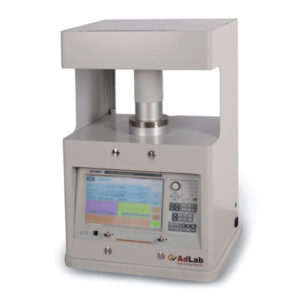
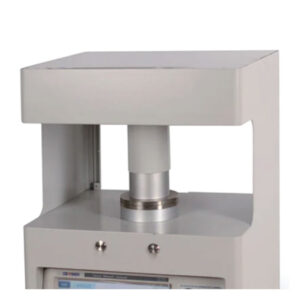
Fabric Anti-Electromagnetic Radiation Performance Tester
High-precision tester for evaluating electromagnetic shielding of fabrics and conductive materials using flange coaxial methods and advanced DSP digital technology.
- Measures electromagnetic shielding across wide frequency ranges
- Features advanced DSP and DDS signal processing system
- Complies with ASTM D4935 and GB/T23326 standards
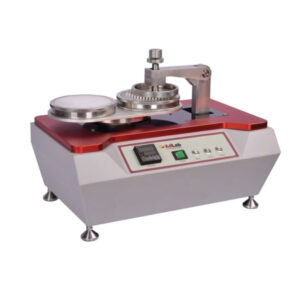
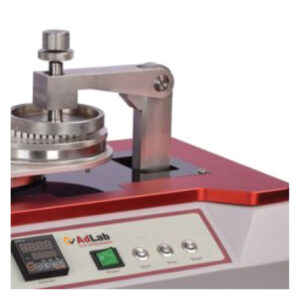
Circular Locus Tester
Reliable fabric pilling tester simulating circular abrasion motion. Adjustable load and brush settings ensure accurate pilling evaluation for all fabric types.
- Conforms to GB/T 4802.1 and JJG040 standards
- Adjustable load and brush height for various fabrics
- Accurate pilling performance evaluation through circular motion testing
Reviews
There are no reviews yet.